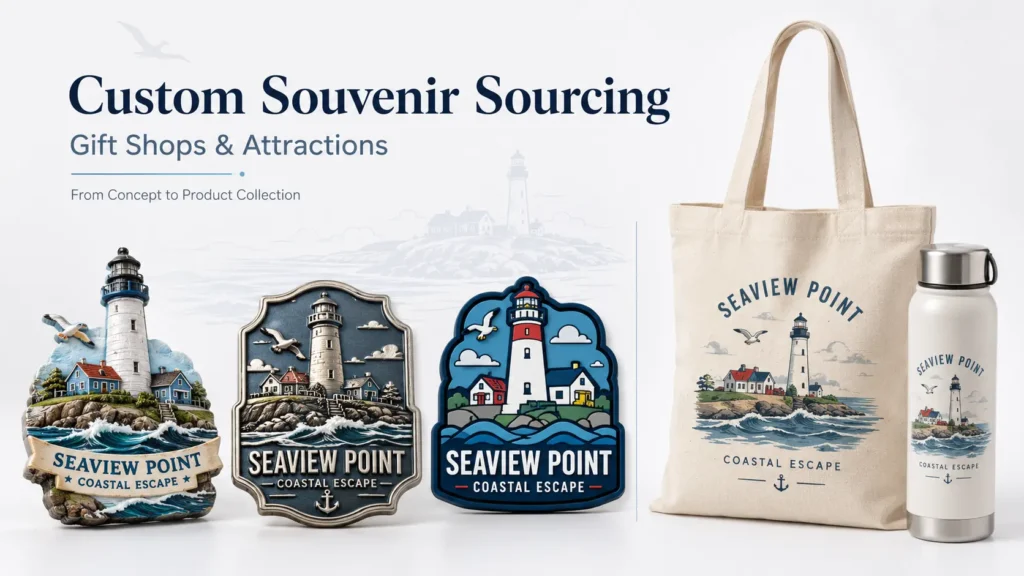
How to Source Custom Souvenir Products for Gift Shops & Attractions
Sourcing custom souvenir products for a gift shop, museum, attraction or destination is easier when the project is treated as a souvenir program, rather than as a list of unrelated products.
A practical sourcing process starts with the destination or attraction concept, then moves through product selection, artwork requirements, MOQ evaluation, mold decisions, sampling, buyer approval and bulk production.
Different souvenir categories follow different development routes. A resin magnet, a die-cast metal magnet and a soft PVC item require mold development, while custom canvas bags and drinkware use different no-mold customization processes.
Understanding these differences before requesting samples can help buyers build a more workable custom souvenir collection.
Start With the Souvenir Program, Not the Product List
A common starting point is to ask:
“What products should we make?”
For a custom souvenir project, a better first question is:
“What destination, attraction or visitor experience should the collection represent?”
That concept may come from:
- a city or tourism destination;
- a museum or exhibition;
- a landmark or attraction;
- wildlife or marine life associated with a location;
- local architecture;
- cultural or scenic references;
- an existing visual identity or artwork system.
The objective at this stage is not to force one design onto every product.
Instead, identify the visual elements that should remain recognizable across the collection. Those elements can then be interpreted differently according to the material and production method of each product category.
A landmark, for example, may become a molded resin scene, a die-cast metal design, a simplified soft PVC graphic, a tote bag artwork or a drinkware decoration.
The concept remains connected, while the physical products do not need to look identical.
Choose Product Families According to the Project
For gift shops and attractions, it is useful to divide product development into three practical groups.
Molded Souvenirs: Resin, Metal and Soft PVC
Resin, metal and soft PVC products all follow a mold-based development route.
| Product Route | Material | Mold | B2B Order MOQ | Sample Lead Time | Bulk Lead Time |
|---|---|---|---|---|---|
| Resin Magnets | Polyresin | Yes | 1,440 pcs/design | 7 days | 30 days |
| Metal Items | Zinc Alloy | Yes | 1,200 pcs/design | 10 days | 30 days |
| Soft PVC Items | PVC / Soft PVC | Yes | 1,000 pcs/design | 7 days | 30 days |
For all three categories, the standard sample quantity is 2 pcs/design.
Normally, one sample is provided for buyer approval and one is retained by Chuzhong Craft as the production reference.
The correct choice between these materials depends on the intended product appearance and artwork structure.
Resin souvenir magnets can use manual hand painting or digital UV inkjet printing on molded polyresin.
A printed Alaska bear and salmon resin magnet, for example, shows how destination and wildlife artwork can be developed on a molded resin base.
Metal souvenir items use zinc alloy and die casting, with confirmed process options including color filling / baking enamel, UV printing, plating and aluminum foil.
A Paris Eiffel Tower metal souvenir magnet is one example of a destination concept interpreted through a die-cast metal structure.
Soft PVC souvenir products use PVC / Soft PVC with a PVC dispensing process. Designs generally need to be considered as practical molded PVC products rather than as unrestricted flat illustrations.
A tourist-attraction soft PVC magnet can therefore be developed around recognizable graphic elements while keeping the design suitable for the production process.
If the main question is specifically whether a magnet project should use Resin, Metal or Soft PVC, buyers can also refer to our separate Resin vs Metal vs PVC Souvenir Magnets buyer guide.
Custom Merchandise: Canvas Bags and Drinkware
Canvas bags and drinkware follow a different sourcing model.
They do not require the same mold-development route used for Resin, Metal and Soft PVC.
Custom Canvas Bags
The standard Canvas Bag program uses:
- B2B Order MOQ: 100 pcs total
- MOQ per Design: 1 pc/design
- Sample Quantity: 2 pcs/design
- Sample Lead Time: 2 days
- Bulk Production Lead Time: typically 7 days, depending on order quantity
- Mold Requirement: No
- Material: 10 oz cotton canvas or polyester-cotton canvas, depending on customer selection
- Customization: DTF heat transfer
The blank bags are purchased and the DTF printing and transfer application are completed in-house.
The distinction between 100 pcs total and 1 pc/design is important.
It does not mean that the B2B order MOQ is one bag. It means that a qualifying 100-piece total order can contain multiple artwork designs, with individual designs starting from one piece.
This structure can be useful when a buyer wants several related artworks within one merchandise program.
A floral canvas tote, for example, represents one possible artwork-led custom merchandise direction; destination-specific artwork can follow the same product-development logic.
Custom Drinkware
Finished custom drinkware includes tumblers, water bottles and mugs using UV-DTF application.
The standard commercial structure is:
- B2B Order MOQ: 100 pcs total
- MOQ per Design: 1 pc/design
- Sample Quantity: 2 pcs/design
- Sample Lead Time: 3 days
- Bulk Production Lead Time: depends on order quantity; 100 pcs typically about 7 days
- Mold Requirement: No
- Main Material: 304 / 201 stainless steel
- Customization: UV-DTF application
Blank drinkware is purchased, while UV-DTF production and application are completed in-house.
As with Canvas Bags, the total B2B order MOQ and the minimum quantity per artwork design must be treated separately.
A sea-turtle water bottle or a destination-themed tumbler can therefore form part of a wider custom merchandise assortment without following the mold-development route required for Resin, Metal or PVC products.
Digital Customization Support: DTF and UV-DTF
DTF and UV-DTF are useful supporting capabilities, but they should not be confused with the core molded souvenir categories.
DTF Transfers are ready-to-press textile transfers produced in-house using digital DTF printing, hot-melt powder application and curing. Individual designs can be produced from 1 pc/design, the sample lead time is 2 days and bulk production time depends on order volume.
UV-DTF Transfers are produced in-house for suitable hard-surface customization. They use digital UV-DTF printing, UV curing and film transfer. Individual designs can also be produced from 1 pc/design, sample lead time is 2 days and bulk production time depends on order volume.
UV-DTF does not require heat for application.
These transfer capabilities support different types of merchandise development, but they are not substitutes for molded Resin, Metal or Soft PVC souvenirs.
A 9-Step Custom Souvenir Sourcing Process
1. Define the Destination or Attraction Concept
Start by identifying what the souvenir collection should represent.
Useful starting materials may include:
- attraction photographs;
- destination references;
- existing artwork;
- logos or visual identity elements;
- sketches;
- examples of important landmarks, animals or objects;
- product references showing the intended general direction.
At this point, it is not necessary to force the concept into one specific product.
The objective is to establish the visual identity first.
2. Select the Product Categories
Next, decide how the concept should be translated into physical products.
Ask whether the project needs:
- molded souvenir magnets or keychains;
- custom textile merchandise;
- finished customized drinkware;
- transfer products for another customization workflow;
- or a combination of several categories.
Product selection should consider both the visual concept and the required quantities.
A design suitable for a metal magnet does not automatically need to be reproduced in exactly the same way on a canvas bag or water bottle.
Each product should use the artwork in a way that fits its own manufacturing and customization route.
3. Prepare Artwork and Design Requirements
For molded products, artwork must be reviewed as a physical product rather than only as a flat image.
This is especially important for:
- relief structure;
- outlines;
- separated color areas;
- small details;
- overall shape;
- elements that need to remain recognizable.
Resin, Metal and Soft PVC each interpret artwork differently.
For Canvas Bags and Drinkware, the project instead needs to consider how the artwork will be applied to the selected blank product.
If the buyer does not yet have finished production artwork, reference images and a clear description of the desired concept can still be useful for initial project evaluation.
4. Evaluate MOQ Before Development
MOQ should be reviewed before committing to a product route.
The current standard quantities are:
- Resin Magnets: 1,440 pcs/design
- Metal Items: 1,200 pcs/design
- Soft PVC Items: 1,000 pcs/design
- Canvas Bags: 100 pcs total, with 1 pc/design minimum
- Drinkware: 100 pcs total, with 1 pc/design minimum
These are different commercial structures.
A buyer planning 1,000 pieces of one molded design has different options from a buyer planning 100 total pieces divided across multiple artwork designs.
Evaluating quantity early avoids developing a product concept that does not fit the intended purchasing structure.
5. Decide Whether a Mold Is Required
This is one of the most important divisions in custom souvenir sourcing.
A mold is required for:
- Resin Magnets
- Metal Items
- Soft PVC Items
A mold is not required for:
- Canvas Bags customized with DTF heat transfer
- Drinkware customized with UV-DTF application
- DTF Transfers
- UV-DTF Transfers
A mold requirement changes the development route because the molded product must first be translated into a manufacturable physical form before sampling.
No-mold customization starts from a selected blank product or transfer format instead.
6. Develop and Review Samples
Sampling should be treated as a production-development stage, not just as a photograph for approval.
Current standard sample information is:
| Category | Sample Quantity | Sample Lead Time |
|---|---|---|
| Resin Magnets | 2 pcs/design | 7 days |
| Metal Items | 2 pcs/design | 10 days |
| Soft PVC Items | 2 pcs/design | 7 days |
| Canvas Bags | 2 pcs/design | 2 days |
| Drinkware | 2 pcs/design | 3 days |
| DTF Transfers | According to customer requirement | 2 days |
| UV-DTF Transfers | According to customer requirement | 2 days |
For Resin, Metal, PVC, Canvas Bags and Drinkware, the normal two-sample arrangement provides one sample for customer approval and one retained by Chuzhong Craft as the production reference.
7. Approve the Production Reference
Before bulk production, review the physical sample against the agreed project requirements.
The buyer should focus on whether the sample correctly represents the approved product direction and artwork.
If changes are required, they should be addressed during the sample stage rather than after bulk production has started.
For the standard Resin, Metal, PVC, Canvas Bag and Drinkware workflow, bulk production proceeds after sample approval.
8. Move Into Bulk Production
Lead times depend on the product route.
For the molded souvenir categories:
- Resin Magnets: 30 days
- Metal Items: 30 days
- Soft PVC Items: 30 days
For Canvas Bags:
- typically 7 days, depending on order quantity.
For Drinkware:
- production depends on order quantity;
- an order of approximately 100 pcs typically takes about 7 days.
DTF and UV-DTF bulk production lead times depend on order volume.
These lead times should not be combined into one general “souvenir production time,” because each category follows a different production model.
9. Plan the Multi-Product Assortment
After the core products are selected, review how the collection works as a whole.
A souvenir program does not need every product to use the same MOQ structure or the same production method.
For example, a buyer may develop:
- one or more molded destination magnet designs;
- a smaller custom merchandise assortment using Canvas Bags;
- customized Drinkware with several related artwork designs.
Because Canvas Bags and Drinkware use a 100 pcs total B2B order MOQ with a 1 pc/design minimum, they offer a different design-quantity structure from the molded categories.
This makes it possible to plan the collection according to the purchasing requirements of each product family rather than forcing every item into one identical quantity model.
How MOQ Changes the Way You Build a Collection
MOQ is not only a quotation detail. It influences how a souvenir assortment can be structured.
For molded souvenirs, MOQ is calculated per design:
- 1,440 pcs/design for Resin;
- 1,200 pcs/design for Metal;
- 1,000 pcs/design for Soft PVC.
That means each additional molded design creates another design-level quantity requirement.
Canvas Bags and Drinkware work differently.
For both categories:
- the B2B order must reach 100 pcs total;
- the minimum quantity for an individual design is 1 pc/design.
A buyer planning many artwork variations should therefore understand the quantity model before selecting product categories.
The lower per-design quantity available within Canvas Bag and Drinkware orders does not make those products replacements for molded souvenirs. It simply gives the buyer another structure for building a broader custom merchandise assortment.
Common Sourcing Mistakes to Avoid
Choosing Products Before Checking Quantity
An attractive product idea may not match the planned quantity.
Check MOQ before investing too much time in a specific development direction.
Treating “1 pc/design” as the Total Order MOQ
For Canvas Bags and Drinkware, 1 pc/design is not the total B2B order MOQ.
The B2B order must reach 100 pcs total.
Assuming Every Custom Product Needs a Mold
Resin, Metal and Soft PVC require molds.
Canvas Bags, Drinkware, DTF Transfers and UV-DTF Transfers do not follow that mold-development route.
Using the Same Artwork Without Adapting It to the Product
A detailed illustration that works for a printed surface may need to be simplified or restructured for a molded item.
The physical manufacturing route should influence artwork development.
Confusing Transfers With Finished Merchandise
A DTF Transfer is not a finished garment.
A UV-DTF Transfer is not a finished tumbler or water bottle.
Canvas Bags and Drinkware are finished customized merchandise categories, while DTF and UV-DTF are transfer products and customization capabilities.
Keeping these product identities clear makes sourcing requirements easier to communicate.
What to Send When Starting a Custom Souvenir Project
A useful first inquiry should include as much of the following information as is already available:
- destination, museum, attraction or project theme;
- reference images or existing artwork;
- preferred product categories, if already decided;
- required quantity or estimated quantity per product;
- number of artwork designs being considered;
- important visual elements that should remain recognizable;
- intended application surface when UV-DTF transfers are involved.
If the product category has not yet been decided, that is also useful information.
The project can first be reviewed according to the concept, artwork direction and quantity requirements.
Jinhua Chuzhong Gift & Home Co., Ltd. supports custom souvenir product development and supply across molded souvenir products and digitally customized merchandise.
Resin, Metal and Soft PVC products follow specialist mold-based production routes. DTF and UV-DTF transfer production is completed in-house, while Canvas Bags and Drinkware combine selected blank products with in-house DTF or UV-DTF customization.
For buyers developing a museum, attraction or destination souvenir collection, the most practical starting point is therefore not to select as many products as possible.
Start with the concept, confirm the quantity structure, choose the appropriate development route, approve the sample and then build the wider assortment around those confirmed decisions.
Planning a Custom Souvenir Collection?
Send us your destination, museum or attraction concept together with any available artwork, reference images and expected quantities. Jinhua Chuzhong Gift & Home Co., Ltd. can review the project according to the product categories, quantity structure and development route before sampling.